
by Sebastian Rock, June 2025

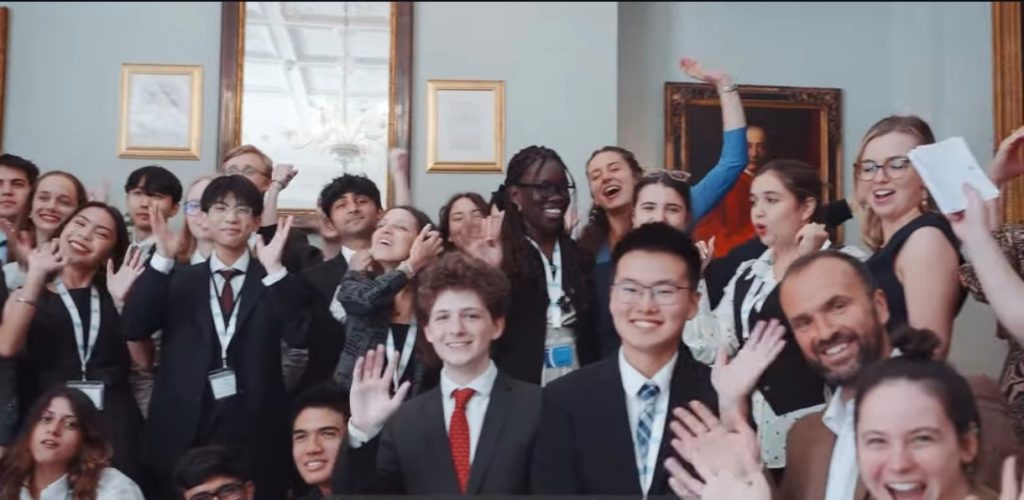
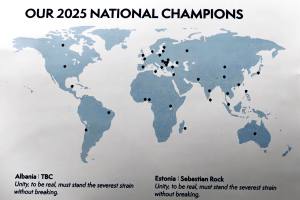
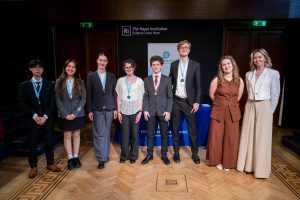
I was given the opportunity to represent Estonia at the International Public Speaking Competition (IPSC) in London this year after winning the national English Olympiad, and I had just over two months to prepare two speeches. I met some of the best speakers in the world, ranging from a Sri Lankan fashion model to an American headed to Stanford to a Malaysian with Spongebob pants (who, in my opinion, was among the most brilliant). I’d like to share what I learned from my week in London.
#1. What even is a world-class speech?!
When I started preparing for the IPSC, the first thing I realized was harsh: I had no clue what a competition-worthy speech even looked like.
I watched all the speeches I could get my hands on from last year’s IPSC. I spent hours analyzing the speeches of Martin Luther King, famous actors, contemporary politicians, and tried to figure out what made them so powerful. But what helped me the most was a young man with underpants on the outside of his suit. Speaking before hundreds of thousands of viewers during the Toastmasters world championships, Darren Tay Wen Jie delivered a speech that felt so natural, it seemed like he was talking to me through the screen. His speech helped me appreciate how to make a speech feel human, through both enunciation and movement. His style helped me really get a picture of what I was aiming for.
At last, I found myself in the Dartmouth house in London, the headquarters of the English-Speaking Union. There, IPSC participants were trained by experts in public speaking. Among them were instructors who had successfully competed in Toastmasters, the same competition as Darren Tay. One of them delivered a speech before us, and it was just about 500 times clearer than the speech I’d prepared. For the second time, I was shocked by a performance and knew I needed to rethink how I understood public speaking.
#2. When I finished my speech, I was only halfway done.
Study great speeches and figure out what to aim for; decide how you’ll interpret the topic; write a few drafts while getting feedback; polish and memorize. That’s what I thought I had to do.
I was wrong. I was missing an element that should have comprised about one third of my process: practicing delivery.
However, I was right to not have practiced delivery at the expense of rushing the other parts of the process. By thinking through what my unique angle on the topic was, I avoided a comment that many speakers got ‒ “your speech lacked original ideas.”
In addition, I was in an ideal position to answer questions. While waiting for my turn to go on stage, I listened to the questions other speakers got and felt frozen with fear. I had absolutely no idea what I would say if it had been my job to answer those questions. Fortunately, when my turn came, I discovered that I was able to answer every question substantively. For that reason, I’m grateful that I wrote my speech about something more niche and in line with my knowledge.
#3. Yes, there are some “cheat codes” to writing a great speech fast.
First, recognize that a story is one of the building blocks of a good speech. When writing a speech quickly, you can search your mind for a good story to include.
Second, know some solid ways to start a speech. You can ask a question that gets the audience to think; cite a statistic that will shock them; make a statement that will leave them completely confused; or tell a story.
Third, almost nobody realizes the power of cutting. One of the coaches at the IPSC shared an experience in which he was coaching a speaker, whose speech included a moving personal story. The coach demanded the author rewrite the story, this time shorter. The author returned with a single sentence that summed up the whole story, and that was all the more powerful.
Fourth, pauses are possibly the most important part of a speech. When writing a speech, your initial view of how many words you can include is likely wrong. Say less; instead, leave more time for pauses and slow down.
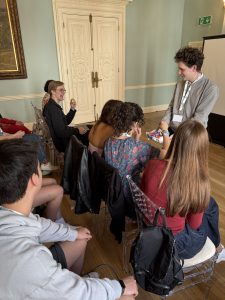
Participating in the IPSC didn’t just teach me things about public speaking, it gave me unforgettable experiences. I still talk with many of the IPSC participants and have made lasting friendships. I can see that the IPSC is, in a small but meaningful way, outreach for Estonia, and not just because I introduced my foreign friends to Kalev candies and shared stories about perfect wifi in the forest. I hope to eventually welcome many of my new friends to Estonia, and just as they represent my connection to their respective countries, I am their link to Estonia. I have learned valuable things from them to use in my home country and hope to have the opportunity to collaborate with them on projects in the future. Some IPSC alumni have floated the idea of creating a public speaking tournament for alumni, and it would be remarkable if such a thing could be held in Estonia!
While the speaking competition may have lasted just one week, it’s impact will reverberate literally around the world for decades. Thanks to the hard work of the organizers in Estonia and the government’s support, I got this opportunity, as will hopefully many after me.
My role is to coach the next representative, which I am more than happy to do. The kind help of my predecessor, as well as the help of the organizers, my parents, and teachers was instrumental in creating this experience. Support was critical for other participants as well—many brought a parent, teacher or friend with them to help them with final preparations, which certainly has a strong impact on the competitor’s performance. With such support and hard work, Estonia may soon bring home the gold!
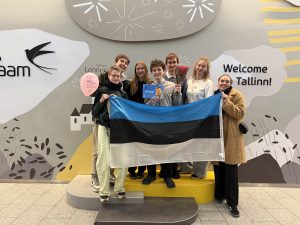
Here is the link to Sebastian’s prepared speech in London
Here is the link to Sebastian’s impromptu speech in London
The ESU International Public Speaking Competition 2025 highlights video on Instagram