
This page brings together all articles produced during the study mobilities carried out within the EATE Erasmus+ project Personalisation of Language Learning with the Help of AI (01-11-2024 – 30-04-2026). The collection showcases insights, experiences, and outcomes from the participating study visits, highlighting innovative approaches to language learning and the integration of artificial intelligence in educational practice.

AI and Critical Thinking – Learning Moments from EATE Erasmus+ training course
Kärt Maasik
We are undeniably in the midst of a major shift in education. The arrival of AI forces us to question what and how we teach our students. In order to brace the winds of change, I participated in a teacher-training course in Barcelona, funded by the EATE Erasmus+ project.
The arrival at Barcelona was as tumultuous as the tidal wave of AI in schools. Just days after the devastating floods in Valencia, Barcelona was drenched in torrential rain, flights were delayed, schedules changed, and civil defence warning issued to all people in the area. Nevertheless, we ploughed on with our group of learners from all corners of Europe – Malta, Greece, Poland, Germany, Bulgaria, and of course Estonia to dig deep into the topic of AI in education.
You might think we launched ourselves into all the different tools and hundreds of applications available and sift through all the possibilities AI has to offer in terms of lesson planning, individualised learning paths, and instantaneous feedback. Not at all! Instead, we focused on the shifts in education – and clearly, the use of AI is inflicting change on the education landscape. That said, it just might be the necessary nudge we all need in order to fully commit to delivering 21st century skills in the classroom. With facts and knowledge readily available and AI to help us with all of that, we can turn our focus to literacy skills, learning skills, and communication skills (critical thinking, creativity, collaboration, initiative, empathy, etc). After all, AI has the power to free up a lot of our time to enable us to deliver these skills which will be vital for our students to thrive in their lives.
The primary focus was on how to make AI tools efficient for ourselves. Our instructor, Yanella Ojeda, urged us to think about the chatbots we are using as personal assistants – and with any new employee, you need to take time to train them to do what they are expected to do, and do it well. Customising a chatbot to meet your needs is a vital first step. Our main focus was on prompt creation – and as with any skill, teachers need to acquire it themselves before they can support students in learning that same skill. I found the CRAFT method very helpful in creating a strong prompt for a chatbot. CRAFT is an abbreviation for the five steps of quality prompt creation – Context, Role, Action, Format, Target. First of all, you should describe the context of the task you’re giving AI – what is the focus, theoretical framework, method etc you want AI to apply? Secondly, you should define the role AI should take on – should it apply itself as social media content creator, education innovator, university professor of social studies? Then, describe what action you want AI to take – design a worksheet, compile a summary, construct a lesson plan, draft a course plan? Next, explain what your preferred format is. Would you like a list, an article, a comparison, a text? Finally, define the target audience – who should this output be suitable for? C1 level secondary students or bored teens?
It is vital to keep in mind that AI can and does hallucinate. Therefore, it is good to include in your customised settings or prompt the request to always inform you of when AI is hallucinating, or alternatively always provide links to where it retrieved the information (Perplexity does this automatically, and hopefully others such as ChatGPT and Claude will soon catch up). What I’ve also found useful is instructing AI (when used in the classroom) not to give in to students’ relentless requests to complete the work on its own and not to provide sample paragraphs or texts unless the student has provided their own draft first.
Of course, there are innumerable AI solutions out there – and I do urge every teacher to go and explore to find what works for them. All the tools I have tried out have been self-explanatory and need only a little bit of tinkering to get them to work for you. I do feel that these tools, however cautiously we might approach applying them in our daily work, do have the power to open up more time for us to deliver what we think is worthwhile teaching. Surprisingly in this AI era, we might actually have more space and time in class for what we might consider most important of all – analytical and creative thinking, curiosity and lifelong learning, empathy and human interaction.
Exploring the Future: AI for Language Teachers—Teacher Training in Sunny Split*
Tuuli Länik
In June, as the school year drew to a close, teachers from across Europe gathered in Split, Croatia, to participate in an inspiring training course: AI for Language Teachers. With the Dalmatian sun shining and the turquoise Adriatic Sea offering a refreshing escape, our days were thoughtfully divided between exploring digital innovation and enjoying the local surroundings.
The Erasmus Split Teacher Training Centre hosted a wide range of courses during the same week, bringing together approximately fifty educators from various countries. While some sessions were specific to individual courses, others allowed participants to interact with teachers from different disciplines. This structure fostered both a lively social environment and valuable professional networking.
The week commenced with a memorable welcome evening, during which all participants were introduced to Croatia, the city of Split, and one another. Teachers brought treats from their home countries, creating an informal yet enriching atmosphere of cultural exchange. Meeting colleagues from diverse backgrounds was undoubtedly one of the most valuable aspects of the course. Not only did we share teaching ideas and classroom practices, but we also engaged in open and honest conversations about our working lives, challenges, and educational contexts. This exchange of perspectives was both eye-opening and grounding, reminding us that, despite differences in our systems, many of our goals, joys, and frustrations are shared.
Collaboration was central to the course. Working together on various tasks allowed us to pool our strengths and learn from one another in real time. Whether co-designing lesson plans using AI tools or testing a scavenger hunt app in the streets of Split, there was a strong sense of shared purpose. Social activities beyond the classroom—swimming, walking, and dining together—helped to forge friendships that will last well beyond the training itself.
A core focus of the course was the exploration of chatbots and their potential in language teaching. We examined how to make the most of tools such as ChatGPT and Perplexity AI, learning how to personalise these platforms to meet specific teaching needs. For example, it is now possible to add custom versions of ChatGPT to your account, including integrations with Canva, Grammarly, or Scholar GPT, depending on your requirements. We also discussed the concept of “temperature” in AI prompts—a technical setting that influences the creativity and directness of the AI’s responses. A low temperature setting (such as 0.2) results in more formal and direct text, while a higher setting (such as 1.0) produces more creative and varied responses.
To deepen our understanding, we investigated how AI responds to incorrect or misleading prompts. This led to a discussion of “AI hallucinations,” where the system generates plausible but inaccurate information. For instance, when asked, “Why do you hallucinate?”, ChatGPT responded by explaining that it sometimes combines plausible but inaccurate memories with patterned expectations, resulting in information that sounds correct but is not grounded in fact. Perplexity AI similarly acknowledged that it may generate illustrative rather than factual content, emphasising the importance of prompt-writing as a skill to be mastered in order to obtain accurate results.
The course included practical sessions on tools that are familiar to many teachers but now have AI-powered features – Canva, Quizizz and Padlet – all of which enable rapid generation lessons or content in a fraction of the usual time.
Although the course focused primarily on AI, two non-AI apps added variety to the experience. Immersal, an augmented reality app, enabled us to overlay digital content onto the real world—imagine students scanning school corridors or outdoor spaces for clues in a language-based AR mystery game. Goosechase, on the other hand, offered a creative and competitive outlet with its scavenger hunt format, encouraging movement, critical thinking, and team bonding.
To conclude the week, we explored Google’s experimental platforms, including Google Arts & Culture and Google Labs. While these platforms are still evolving, they offer rich resources for teachers aiming to integrate culture and innovation into their English lessons. From virtual audio tours to AI-generated poetry and music, the potential for cross-curricular exploration is immense. One particularly useful tool for language learning was Little Language Lessons (from labs.google), which provides a variety of vocabulary-building activities and resources.
Ultimately, beyond the tools and technology, what stood out most was the collaborative spirit among participants. As the influence of AI in education continues to grow, experiences such as this remind us that teachers are not mere passengers on this journey—we are navigators. With the right tools and a sense of curiosity, the path forward is not only manageable but genuinely enjoyable.
*This article has been written by Tuuli Länik with the help of ChatGPT and Perplexity AI with to test AI’s ability to create exactly what is asked. I gave my prompt with details about the course to ChatGPT and then edited it myself. Next, I copied the article into Perplexity AI and asked it to give feedback in terms of consistency in style and the temperature level – set to 0.2. The feedback was thorough and to there were suggestions for improvement. I finally asked Perplexity to use the suggestions and improve it. After that, I did my final editing. It took approximately 2 hours to finalise the article.
Integrating ICT, New Technologies, and AI Tools into Teaching and Education
Mustafa Soysal
Following my student Johanna Saska’s achievement of winning first place in the EATE Open Public Speaking Competition on 2 April 2025, where she represented Tallinn 21st School, I was granted the opportunity to attend an Erasmus+ course funded by the Estonian Association of Teachers of English. I chose to attend the course titled “Integrating ICT, New Technologies, and AI Tools into Teaching and Education,” which took place in Palermo, Italy, from 8 to 14 June 2025 and was organised by the Erasmus Learning Academy.
The course began on Sunday with a get-together of teachers from various European countries, followed by a short tour of Palermo’s city centre and a group dinner. Comprised of a total of 35 lessons, the training course not only highlighted the importance of new technologies and ICT tools in education but also introduced us to a wide range of practical tools that we could effectively incorporate into our own teaching practices. The training course was structured in a way that each day we were introduced to new ICT tools. Depending on our teaching expertise and areas of interest, we had the opportunity to practice using these tools and present them to the class. We completed tasks individually, in pairs, or in groups. The course was highly interactive, which encouraged collaboration among teachers, allowing us to exchange ideas and receive feedback.
Regarding the tools, we were introduced to platforms such as Padlet, Mentimeter, Baamboozle, Socrative, Quizlet, ChatGPT, Magic School, Gamma, Edpuzzle, and TED-Ed. Here is a brief overview of the tools introduced, along with their most appropriate uses in educational settings:
Padlet is a collaborative online board that allows teachers and students to post notes, links, images, and more in real time. By using Padlet, I created a self-assessment exercise on Reported Speech, allowing students to reflect on their understanding interactively.
Mentimeter is an interactive presentation tool that enables real-time polls, quizzes, and word clouds. I used Mentimeter to design an engaging self-assessment activity on Passive Voice, focusing on its structure and usage.
Baamboozle is a game-based learning platform ideal for classroom quizzes and collaborative tasks. Together with another teacher, I prepared a game comparing the Polish and Estonian educational systems, making the topic both fun and informative.
Socrative is a formative assessment tool that helps teachers create quick quizzes and get instant feedback from students.
Quizlet is a study tool that allows users to create flashcards and practice games. I created a flashcard set featuring Shakespeare’s mainstream plays and their major characters to support literature revision.
ChatGPT is an AI-powered language tool that supports teachers in generating content, writing prompts, and enhancing lesson creativity. During the course, I worked with a partner to create a collaborative lesson in which we gave step-by-step instructions on how to make pierogi with pistachio, combining language learning with cultural elements in an engaging way.
Magic School is an AI tool designed for educators to create rubrics, lesson plans, and more. I used Magic School to design a detailed rubric for evaluating students’ use of Inversion.
Gamma is a presentation platform that turns outlines into visually appealing slides quickly. Using Gamma, I created a lesson presentation on Charles Dickens’s Great Expectations, which combined visuals and structure effectively.
Edpuzzle is a platform that lets teachers add questions and notes to videos for interactive lessons. I designed a video lesson on Experiential Learning, incorporating comprehension checks and reflection tasks throughout the clip.
LearningApps is a tool that helps teachers create interactive learning modules like matching exercises and puzzles. I used it to create a vocabulary puzzle tailored to a unit from one of our coursebooks.
TED-Ed offers educational videos and lessons built around TED Talks and animations.
Overall, this course gave us a valuable opportunity to explore new technologies and strengthen our ICT skills in meaningful ways. We gained fresh insights into the role of Artificial Intelligence in education and learned how to design engaging multimedia content for our classrooms. We also discovered practical tools, apps, and platforms to support teaching and learning, and explored innovative methods to assess our students’ knowledge in real-time. Overall, the course empowered us to enhance our digital competence and bring modern, interactive strategies into our everyday teaching practice.
All in all, attending the course in Sicily was an enriching experience both professionally and culturally. Sicily, a stunning island in the Mediterranean Sea, was even larger and more vibrant than I had imagined, with a population of 4.78 million. Beyond the training sessions, we had the chance to explore the island’s rich cultural heritage through visits to its museums, churches, cathedrals, marketplaces, and historical sights.
I am sincerely grateful to EATE for providing me with this opportunity, and I would wholeheartedly recommend the course to anyone interested in developing their skills while experiencing a new culture.
How to manage stress and conflict?
Riina Kuuskor, Tallinn French School
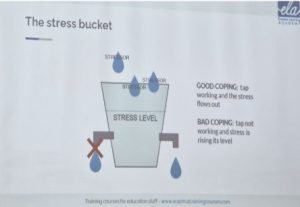
Avoiding stress altogether is probably impossible, but don’t we all want to find our way to be as little disturbed by it as possible? As burnout syndrome is a growing trend among teachers as well as students, every little tip and positive experience to put into practice counts.
I had been trying to raise my personal awareness on that matter for some time already and discovering that such a course was available really filled me with hope.
At the end of March I participated in the course co-funded by Erasmus+ Programme “Stress and Conflict Management: the way to resilience and satisfaction” in Palermo. I had done almost no prior research on the venue, so I was pleasantly surprised that some nice tours of the city were included in the programme. However, the capital of Sicily received us in a rather grim mood – pouring down for at least four days out of seven!
If it had been a holiday trip, I’d call it ruined by bad weather, but it didn’t disturb the course at all since the sessions were held in the small seminar room of the hotel.
This piece of writing is definitely not about Palermo but the key insights from the course, so I’ll just say this city is definitely worth a visit for several reasons. Number one for me is a mixture of many different architectural styles – Arab, Byzantine, Norman, Renaissance – to name the most eye-catching. I suggest you go to see an opera at the Massimo Theatre (I didn’t have the chance) or at least take a tour of the building, stroll along the narrow streets of the old town and try local (street) food. If you can, take a train to some small town along the coast to get a better picture of Sicily.
People are loud and friendly and remember that they may not understand English at all.
Now about the course itself. Most of us 14 were teachers of different subjects, but there were also two school principals, three school psychologists and one social work coordinator; the countries included Germany (8), Romania (3), Ireland (1), Finland (1) and Estonia. The course instructor was a young charming teacher trainer and practicing psychologist Giulia Amato, under whose guidance we gathered every morning/afternoon to get a short theoretical input, followed by group discussions. The course was not in lecture format, which was very good, but solving different situations in groups where members shifted after every task.
This is an example of how sessions started:
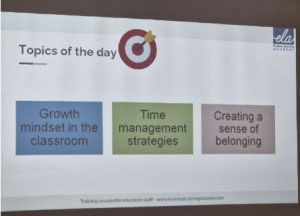
This is what we achieved through different activities:
- Learned about the dynamics and characteristics of stress, its causes and effects;
- Got an insight into our own individual patterns of stress response;
- Learned how to apply stress management tools to typical education situations (eg parent-teacher relationship, bullying, etc);
- Practiced some stress and conflict management tools and techniques (I’ll briefly share some of them in the next section);
- Made contacts and shared experience with colleagues from other European countries.
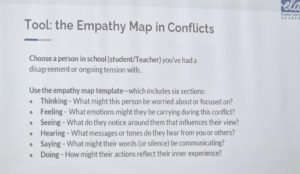
This is an example of a lead-in to group discussions:
Finally, here are some notes that I made for myself and hope to bear in mind or put into practice:
- Learn to be assertive. This communication style is always a 2-way flow. Differently from passive, aggressive and passive/aggressive, it is solution-focused. Use the expressions “As I understand…”, “Let me explain…”, “Let’s define the issue and then try to …”. Do not set conditions, do not apologize excessively, do not use expressions “I knew it!”, “You must…”, You always/never…”.
To be assertive also means being able to say NO. Give yourself some time to think why you sometimes say YES although you should say NO – Is it because you feel guilty? Because you want to be liked? Any other reason?
I have to say it was one of the hardest tasks to say NO in the role play.
- Everything that feels uncomfortable doesn’t have to be negative stress. Moderate stress keeps us engaged and motivated.
- Try to overcome a fixed mindset and develop a growth mindset both in yourself and your students. Don’t blame yourself when you fail, don’t seek shortcuts or compare yourself with others who performed worse to protect your ego. As a teacher, emphasize effort over ability. Pay attention to the language when praising and normalize struggle. Remember the power of YET (You haven’t reached the score YET, but…). A good point from our instructor: “Growth mindset helps students to focus on the learning process rather than simply trying to appear smart”.
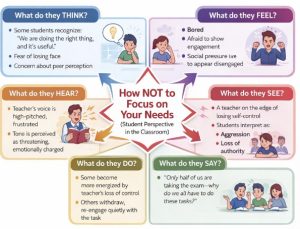
- Learn to see a problem through other people’s eyes.Here we had to solve a conflict in classroom about doing a task. The teacher should be aware of how many different feelings and interpretations of the situation there are at the same time and adjust her/his response accordingly.
- Develop your skills of setting priorities and share the tips with students. Use the Eisenhower matrix to differentiate the tasks: DO – when the task is urgent and important; PLAN – important, but not urgent; DELEGATE – urgent, but not important that you do it; ELIMINATE – not important, not urgent.
- Make the difference between empathy and sympathy. Don’t try to fix the problem or give a solution. Empathy is feeling WITH, sympathy is feeling ABOUT. Empathy is just about connecting: “I really don’t know what to say but I’m glad you told me.” Don’t react with “AT LEAST (you have good grades in maths)”.
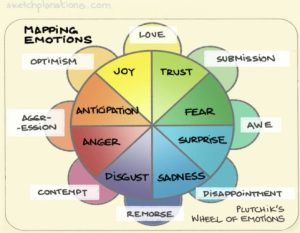
- Learn yourself and teach students to identify/name the emotion that overwhelms them. It might be a good idea to have the Plutchik wheel of emotions on the classroom wall and ask for students’ opinion (How did you feel doing this task?), especially in case of junior classes.
After the course, I’m full of thoughts and enthusiasm, quite sure I’ll put some of the tips received into practice as soon as possible. I’m really glad the course was practical, not theoretical and can’t deny the extra value of working side by side with Sarah from Ireland, thus enjoying the language benefit. I’m grateful to all the interesting people I exchanged ideas with and to EATE for this opportunity to develop as an educator.
Erasmus+ Training Experience: More Than Just a Course
Ineta Puidet, Pärnu Sütevaka Gümnaasium
“EFFECTIVE COMMUNICATION AND PUBLIC SPEAKING FOR TEACHERS AND EDUCATION STAFF”
Porto, Portugal 8.-14.03.2026
When I found out that I had the opportunity to participate in an Erasmus+ course, I was genuinely excited. I chose Portugal partly because I had never been there before, so naturally, I had quite high expectations – not only for the course itself but also for the overall experience.
Everything leading up to the trip went smoothly. The information was provided on time, and the organisation seemed well-structured. However, my first small disappointment came about a month before departure, when I received details about the accommodation. The promotional materials had created an image of a sunny, almost idyllic setting — people working on terraces, surrounded by greenery and light. In reality, the venue turned out to be a modest three-star building that felt somewhat stuck in the 1990s. It was perfectly clean and comfortable, but not quite what I had imagined. The contrast became even more noticeable during the course itself, as our training room was located in the basement – with no windows at all.
Still, first impressions can be misleading. After reading reviews online, I expected the breakfast to be rather basic — mostly bread, as many reviewers had warned. And while there was indeed a lot of bread, it turned out to be one of the highlights of the stay. The variety was impressive, everything was fresh and delicious, and most importantly, there were freshly made pastels de nata. I made it my mission to eat as many as possible, convinced I would get tired of them by the time I went home — but that never happened.
Porto welcomed us with green grass, blooming tulips, and palm trees along the ocean coast. We were lucky with the weather and had several warm, sunny days, which made exploring the city even more enjoyable. We crossed the Luis Bridge on foot, visited the well-known Lello bookshop, and even took a trip to the picturesque and colourful town of Aveiro. Along the way, we experienced local culture through food as well — trying the traditional francesinha and bifana.
One place that stayed with me in particular was Sao Bento train station. I have always liked old train stations with their large waiting halls — there is something about them: the quiet excitement of travelling combined with a sense of history, as if time has been preserved within the walls. But this one — Sao Bento, in the heart of Porto — felt especially memorable. The blue-and-white tiles covering the hall from floor to ceiling tell detailed stories, and you can easily spend a long time simply observing one scene after another.
These moments outside the classroom added an important dimension to the experience, allowing us to connect more informally and experience the local culture together.
Meanwhile — far from the sunshine of Porto — back in cold and still snowy Estonia, public speaking had gained more importance than ever. In the 2025/2026 school year, it was introduced as the only format of the national Olympiad at the high school level, and it is now also appearing more at lower levels, for example through competitions such as the EATE Open 2026 speech contest held by Tallinn French School for 7th and 8th grade students. This was one of the main reasons why I chose this course, with a 52 very clear goal in mind: to become a better teacher in this area. Naturally, I hoped to gain concrete tools that I could immediately apply in my classroom.
However, what I gained was slightly different — and, in many ways, even more valuable.
During the course, I had the chance to step back into the role of a student and experience firsthand the kinds of activities I regularly ask my own students to do. And, as it turns out, it is quite different to be on the other side. Instead of just talking about communication, we were constantly expected to act, react, and speak — sometimes with very little preparation. Topics such as creativity, assertiveness, non-verbal communication, and effective feedback were not just theoretical, but something we had to practise ourselves.
The most impactful part of the course was preparing and delivering several speeches throughout the week. We didn’t jump straight into long presentations, but built up to them step by step. It started with a short two-minute self-introduction, followed by a prepared speech on an unpopular opinion — which turned out to be both fun and slightly uncomfortable at times. One of the most memorable activities was a PowerPoint Karaoke task: an impromptu speech where we had to improvise on a topic based on random images appearing on the screen. This was a real challenge for the speaker, but highly entertaining for the audience.
The main activity the course was building towards was the delivery of pre-prepared speeches. We presented them in front of the group, recorded them, and later analysed them both individually and with peers, providing structured feedback to one another. Interestingly, this was the moment when I felt slightly out of my comfort zone. Giving feedback is something I am used to as a teacher, but receiving it — especially from peers — felt different. I found myself feeling a bit shy, even though the atmosphere was supportive. At the same time, the feedback I received was valuable and gave me useful pointers for improvement.
During the training, I sometimes felt that much of it was familiar — perhaps a few fresh activity ideas, but nothing entirely new. However, the real impact only became clear after I returned to the classroom, when I found myself quoting the instructor and drawing on ideas we had explored during the course.
For example, one idea that stayed with me was: never apologise before a presentation. Even if you feel underprepared, there is no need to point it out — your audience might not notice, and in any case, they are on your side. Another important insight was understanding how common the fear of public speaking actually is. It is often cited as even greater than the fear of death, as it triggers an immediate sense of social judgment, rejection, and vulnerability. Realising this helped me better understand my students and the anxiety they may feel when asked to speak in front of others. It also highlighted the importance of creating a supportive environment in the classroom. At the same time, it was a good reminder that this discomfort is something we all experience — and that confidence comes with practice.
Another practical takeaway was the idea of structuring thoughts into three clear points — the “rule of three.” This approach can be practised not only in the classroom, but also in everyday situations — with friends, family, or colleagues. You can use a simple “instant speech” to argue for the movie you want to see, to convince your child to clean their room, or even to thank someone for a thoughtful gift. I often find myself drifting into side stories and losing the main point I want to make. This simple structure has helped me become more focused and clearer in my own communication as well.
Overall, this Erasmus+ experience was both professionally and personally enriching. It provided me with practical tools, new perspectives, and, perhaps most importantly, the opportunity to see learning again from my students’ point of view. Stepping into the role of a learner reminded me that confidence, clarity, and structure do not come automatically — they need to be practised, supported, and encouraged. This is something I will carry with me into my classroom.
Learning Through Job Shadowing: A Spring Visit to Bratislava
Taivi Õigus
Having previously attended Erasmus+ teacher training courses, I decided to try job shadowing this time. The 1st Independent High School in Bratislava (hereinafter referred to as 1SG) was recommended by a colleague of mine. Although I did not take the idea very seriously at first, I eventually found myself in the chilly and slightly sleepy city on the Danube.
The 1st private grammar school and secondary school for students with general intellectual talent was established in 1991, with three co-founders still employed there. The Private Elementary School for Students with General Intellectual Giftedness was opened in 2009. Currently, the school comprises three different private study options: a nine-year elementary school, an eight-year grammar school, and a four-year grammar school. The last two share the same facilities, while the first is located in an adjacent building.
The school’s admission requirements are strict. The assessment of giftedness for admission to the first grade of the secondary school for students with general intellectual ability is conducted at a counselling centre. Identifying intellectual giftedness involves not only evaluating a child’s intellectual level in relation to their age (e.g. early reading and mathematical skills already evident in preschool) but also assessing their maturity, motivation, memory, social skills, creativity, concentration, and intellectual curiosity. The admission procedure for both the eight-year and four-year study programmes is based on written entrance examinations and school reports from previous studies. The competition is intense.
In most cases, each year group consists of a single class. In both primary and eight-year grammar school, each class is assigned a name (e.g. ‘Anchors’, ‘Jewels’, ‘Skippers’). In the four-year grammar school, however, only the first two years have named classes. Upon graduation, posters representing the cohort are displayed on the school walls.
Undoubtedly, this is a school of opportunities. In today’s fast-changing world, factual knowledge or expertise in a single field is no longer sufficient. Instead, flexibility and creativity, essential prerequisites for the future, are placed at the heart of the learning process. The school’s primary aim is to develop key life competencies, such as critical thinking, the confidence to ask questions, the ability to argue effectively, teamwork, and efficient planning, as well as strong IT skills.
These competencies are fostered from an early age and extend beyond individual subjects. They are developed through a variety of learning methods, including project-based learning, experiential learning, case studies, discussions with experts, and a balance of independent and group work, along with open-ended tasks. There is a strong emphasis on intrinsic motivation and collaboration. The school also places considerable importance on non-formal education and extracurricular activities. Learning is reinforced through museum visits and a wide range of excursions (including eco-excursions), where students apply their knowledge in real-life and foreign language settings.
1SG is engaged in several international projects and activities. The prestigious DofE (the Duke of Edinburgh Award) programme focuses on students’ independence and responsibility, helping them set goals for personal growth in different areas. By receiving recognition of their abilities, school-leavers gain a stronger advantage in the admissions process at prestigious universities. An impressive 90% of students continue their studies at universities, mostly abroad.
During their high school studies, a significant number of students are offered an international education through the Centre for Talented Youth, which enables gifted and motivated students to take online courses at American universities and high schools. This initiative has led to 1SG being officially recognised as a Partner School of the Centre for Talented Youth, distinguishing it as one of the few schools in Slovakia to hold this status.
The Erasmus+ Skills Development Fund has enabled many teachers and students to participate in courses and activities abroad. The Pan-European Educational Project is based on week-long exchanges where students from seven European high schools meet and work on a pre-selected topic in the areas of culture, history, and science, complemented by the International Theatre Project organised by one of the schools. The primary aim is to gain international experience, establish contacts, and explore other cultures. No less important is encouraging students’ creativity, networking, language and IT skills and strengthening empathy in young people.
During the final two years of study, the main focus is on preparation for the Maturita school-leaving examination. Students follow a structured programme in which they can shape their academic profile according to their future study plans. While core subjects such as Slovak, mathematics, foreign languages, and physical education remain compulsory, students choose additional subjects and seminars aligned with their intended university pathway. These may include a natural science profile (e.g. biology, chemistry, physics), a social science profile (e.g. history, social science, philosophy), or a mathematical-informatics profile. Students can also choose from different seminar pathways, although timetable constraints may limit such combinations.
In the last two years of study, students from both the eight-year and four-year programmes (forms 7–8 and years 3–4 respectively) are taught together in the jointly selected modules. In English, students taught by the same teacher attend regular lessons alongside optional seminar classes, such as Business English or Humanities English, held in double periods. English is optional in the final year, although most students continue with it. The Maturita examination, which consists of written papers in March and oral exams in May, includes Slovak, a foreign language at B2 level, and two additional subjects chosen according to students’ academic focus. Overall, the programme emphasises long-term goal setting, informed subject choice, and systematic preparation for further study.
During my job shadowing week at 1SG, I observed a wide variety of English and CLIL lessons across different year groups, which offered valuable insight into teaching approaches combining traditional and contemporary practices effectively. I attended both 45-minute and 90-minute lessons, including regular English classes, seminars, and CLIL sessions, which allowed me to compare different teaching styles and learning environments for students mostly in the 15–19 age range.
A particularly striking aspect is the strong emphasis on project-based and experiential learning. In CLIL lessons, students are engaged in higher-order thinking tasks such as evaluating historical events, debating contemporary issues (e.g. the use of AI in education), conducting SWOT analyses, and presenting research findings. These activities require students to think critically, justify their opinions, and work collaboratively. In the regular language classroom, a variety of effective teaching methods and approaches are employed to support active learning and student engagement.
Teachers implement authentic materials, e.g. magazines, to enhance relevance, as well as literature, creative writing, role plays, and real-life communication tasks to develop practical language skills in meaningful contexts. I was exposed to effective strategies for vocabulary acquisition and consolidation, pronunciation correction, and formative assessment, including peer feedback, structured reflective tasks, and continuous teacher–student interaction. Lessons incorporate efficient recall and summarising strategies, alongside an emphasis on reasoned argumentation, with students expected to justify their opinions. Such practices demonstrate how key competencies can be developed across different subjects and learning contexts.
Another important area is the integration of digital tools and technologies into classroom practice. Teachers make effective use of online resources, videos, and interactive tools such as Kahoot to increase engagement and support different learning styles. At the same time, students are encouraged to reflect critically on the role of AI, e.g. in discussions about its advantages, limitations, and ethical use in education. This balanced approach highlight how digital tools can enhance learning while still promoting independent thinking. Overall, the experience provided valuable insights into student-centred teaching and the effective use of ICT, while also encouraging reflection on how these approaches can be adapted to support personalised learning and improve student engagement in different educational contexts.
The school fosters a supportive and low-pressure atmosphere where students are encouraged to communicate freely with both their teachers and peers, collaborate, and view mistakes as a natural part of the learning process. Students are supported in active participation and feel confident to experiment with language.
Teachers act as facilitators and trusted authorities, guiding students through interactive activities, including pair and group work, presentations, discussions and debates, and world cafe-style activities. Language learning is frequently organised in a circle format, fostering interaction and a sense of equality between the teacher and students. These approaches clearly support meaningful learning and knowledge acquisition. Collaborative, cross-curricular learning is evident and forms an essential part of the everyday learning process.
Beyond the classroom, relationships within the school community stand out as a key strength. Interaction among teachers is notably warm and collegial, creating an atmosphere often described as a “big family”, shaped by the leadership of the principal and vice-principal. This positive environment extends to teacher–student relationships, which are characterised by mutual respect and openness. In line with private school standards, strong parental involvement reinforces a shared commitment to students’ academic success and overall development.
Despite the many strengths and the admirable, enviable aspects of both learning and teaching practices outlined above, it is important to acknowledge the advantages of our own physical learning environment, such as renovated facilities, well-equipped classrooms, and modern digital equipment. Furthermore, from a teacher’s perspective, having a dedicated classroom, rather than moving between rooms with teaching materials, is particularly beneficial for maintaining organisation and lesson continuity. At times, however, the level of freedom and flexibility seemed excessive.
Erasmus job shadowing proves to be an eye-opening experience even for experienced teachers, offering valuable insights into different educational approaches and encouraging reflection on one’s own teaching practice. Such experiences contribute to both professional growth and renewed motivation.
Personalised Language Learning in Practice: Job Shadowing at a Polish Fee-Paying School
Ksenia Kaleis, Narva Täiskasvanute Kool
Professional development plays an important role in maintaining high-quality language education. I would like to express my sincere gratitude to the Estonian Association of Teachers of English (EATE) for the opportunity to participate in the Erasmus+ project Personalisation of Language Learning with the Help of AI and to gain first-hand experience by observing everyday teaching and learning in a Polish fee-paying school.
My job shadowing mobility took place from 23 to 27 March 2026 at Społeczna Szkoła Podstawowa nr 2 STO in Warsaw. The school was selected because of its learner-centred philosophy, innovative teaching practices and extensive experience in Erasmus+ projects. The programme included English lessons with mentor Aniela Kaufman, observations of German, Spanish, French and Polish lessons, as well as several educational activities organised outside the traditional classroom.
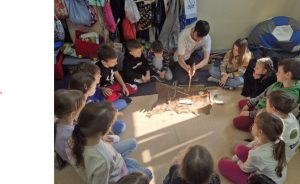
Personalised learning is one of the key principles of the school’s educational approach. Flexible grouping, differentiated classroom activities, project-based learning and formative assessment allow teachers to respond to students’ different needs while keeping every learner actively engaged. Language lessons are designed not only to develop linguistic competence but also communication, critical thinking and presentation skills.
One lesson clearly demonstrated this approach. Students revised vocabulary related to environmental protection and endangered species while preparing two-minute monologues using three different types of conditionals. They then presented their work to the class, combining grammar, vocabulary and public speaking within a meaningful real-life context.
Project-based learning is a regular part of the English curriculum. During my visit, I observed the project Polish Hero Presentation, where students worked in self-selected pairs over the course of one month. They planned their own work, divided responsibilities, selected information sources and monitored their progress. This approach develops language competence alongside teamwork, responsibility, communication and time-management skills while giving students greater ownership of their learning.
Another valuable practice was the use of formative assessment. Instead of simply receiving marks, students analysed completed tests together with the teacher, discussed their mistakes and identified areas requiring further practice. Assessment was clearly used as a tool for learning rather than only for measuring achievement.
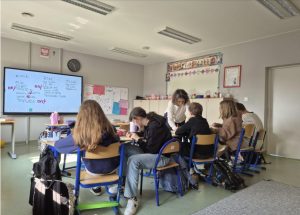
The school also places a strong emphasis on non-formal education. Students can choose from more than thirty extracurricular activities, and learning frequently extends beyond the classroom. During the mobility, I attended a museum lesson on Greek mythology and an archaeological workshop where students explored human evolution through interactive activities and practical tasks. Both examples demonstrated how authentic experiences increase motivation and make learning more meaningful.
One of the objectives of the mobility was to observe how digital technologies support personalised language learning. Platforms such as Wordwall, Kahoot and Quizlet were regularly used to revise vocabulary, check understanding and maintain a high level of student engagement. The experience also provided an opportunity to reflect on the use of AI-supported educational applications in language teaching and to compare current practices in Poland and Estonia.
The mobility also offered valuable insight into the school’s professional culture. Although teachers demonstrated very different teaching styles, every lesson reflected high pedagogical standards, effective classroom management and strong subject expertise. One particularly memorable experience was participating in a weekly Latin dance session organised voluntarily for teachers. It offered colleagues an opportunity to relax, recharge and spend time together outside their professional roles, highlighting the importance of teacher well-being and burnout prevention.
Reflecting on the mobility naturally leads to the question of which practices could be transferred to the Estonian educational context. While some features of a fee-paying school, such as smaller classes or extensive extracurricular provision, are difficult to replicate, project-based learning appears highly transferable. Introducing interdisciplinary projects on a regular basis could strengthen student motivation, develop soft skills and create meaningful connections between English and other subjects.
The mobility also confirmed that Estonia has made remarkable progress in integrating AI-supported educational applications into language teaching. Based on my professional experience and observations during international Erasmus+ activities, Estonia appears to be among the leading European countries in this area. AI and digital tools are increasingly supporting personalised learning both in the classroom and through independent study.
Finally, meetings with the school leadership opened discussions about future cooperation, including the possibility of developing a joint Erasmus+ KA2 project for students. Such collaboration would provide young people with opportunities not only to improve their language skills but also to strengthen intercultural communication and experience European cooperation firsthand.
Overall, the mobility fully achieved its objectives. It provided valuable ideas for developing personalised language learning, project-based learning, formative assessment and the meaningful use of digital technologies. Most importantly, it confirmed that international job shadowing is not only about discovering good practices abroad but also about identifying realistic ideas that can enrich teaching and learning in our own schools.